A team led by professors Cheng Qiang and Qi Xiaotian from the College of Chemistry and Molecular Sciences at Wuhan University has achieved a breakthrough in nickel-catalyzed carbon-heteroatom coupling of two nucleophiles.
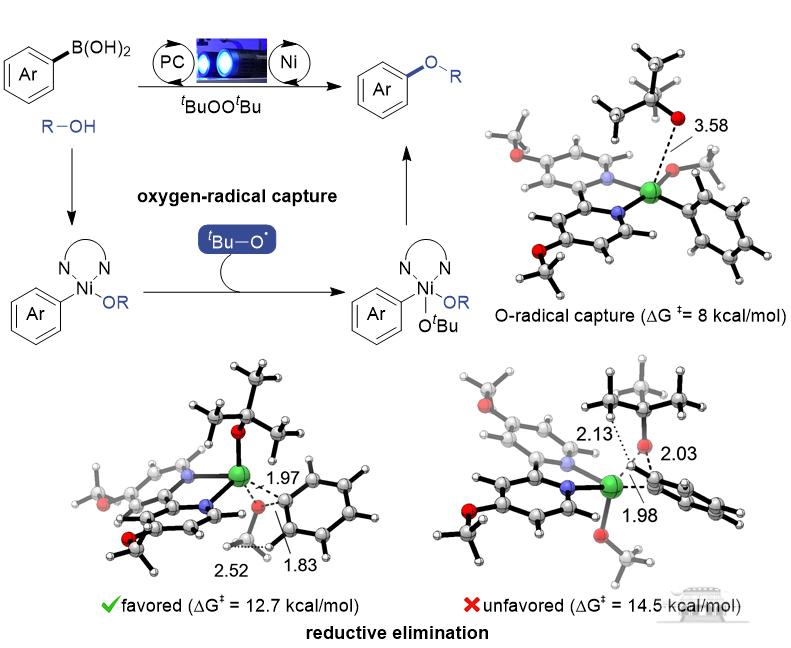
Their latest research, Oxygen-Radical Capture Enabled Nickel-Catalyzed Carbon (sp2)-Heteroatom Coupling of Two Nucleophiles, has been published in Angewandte Chemie International Edition, demonstrating an oxygen radical-promoted nickel-catalyzed C–O etherification reaction of arylboronic acids.
Traditional copper-catalyzed Chan-Lam etherification reactions struggle with electron-deficient arylboronic acids and bulky alcohols, necessitating alternative metal-catalyzed approaches.
However, nickel-catalyzed Chan-Lam-type etherification reactions have not been reported due to the thermodynamic challenges of reductive elimination from aryl-nickel(II)-alkoxy intermediates and the propensity for β-hydride elimination to form carbonyl byproducts.
Although C(sp2)–O reductive elimination has been achieved in nickel(III) chemistry, it relies on aryl (pseudo)halide precursors, leaving the C–O coupling reaction of arylboronic acid precursors an unresolved challenge in nickel catalysis.
The team employed di-tert-butyl peroxide (DTBP) as an oxidant and utilized photonic nickel co-catalysis to achieve selective coupling reactions between arylboronic acids and O-, N-, S-, and P-nucleophiles.
Mechanistic experiments and DFT calculations revealed that the photogenerated tert-butoxy radical rapidly captures the aryl-Ni(II)-alkoxy intermediate, forming a five-coordinate Ni(III) species.
This species undergoes C(sp2)–O reductive elimination to selectively produce aryl ethers while releasing low-valent nickel, which is reoxidized to regenerate the Ni(II) catalyst, completing the catalytic cycle.
This method, under mild reaction conditions, addresses the challenges of nickel-catalyzed Chan-Lam-type etherification reactions and is applicable to constructing various carbon-heteroatom bonds, facilitating the late-stage modification of natural products and pharmaceutical molecules.
 中文
中文