Professor Zhou Haibing and his team from the School of Pharmaceutical Sciences at Wuhan University have made significant progress in the dual-targeted drug development for endocrine-resistant breast cancer, with their latest findings published in the Journal of Medicinal Chemistry.
ERα/HDAC6 dual-targeted PROTAC: A multi-mechanism approach to overcome resistance
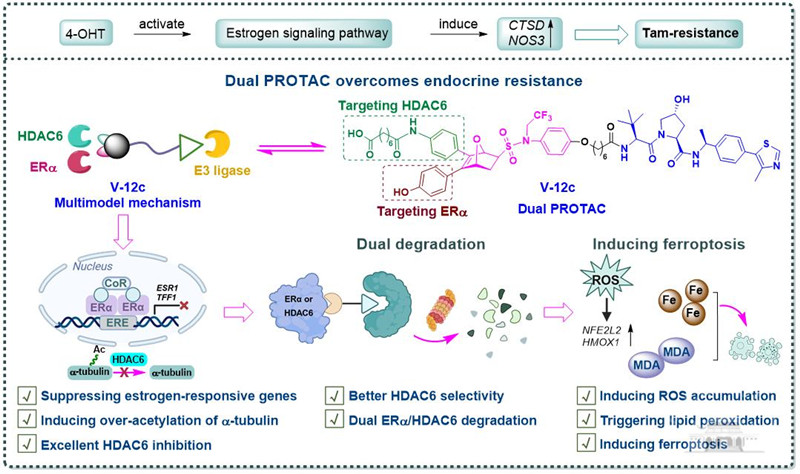
The paper, Discovery of Effective Dual PROTAC Degraders with Synergistic Antitumor Activity for Overcoming Tamoxifen-Resistant Breast Cancer, highlights that Histone Deacetylase 6 (HDAC6) is highly expressed in resistant breast cancer, where it enhances cell motility and regulates autophagy and ferroptosis, thereby promoting endocrine resistance.
The team introduced a novel dual-targeted PROTAC degrader, V-12c, which targets Estrogen Receptor α (ERα) and HDAC6, degrading both resistance-driving proteins.
V-12c inhibited tumor growth in MCF-7 and tamoxifen-resistant LCC2 xenograft models, outperforming the clinical anti-tumor drugs Fulvestrant and SAHA. Throughout treatment, no abnormalities were observed in the mice's body weight or major organs, indicating a good safety profile.
ERα LBP/CBS dual-site targeted PROTAC: A new paradigm in resistance management
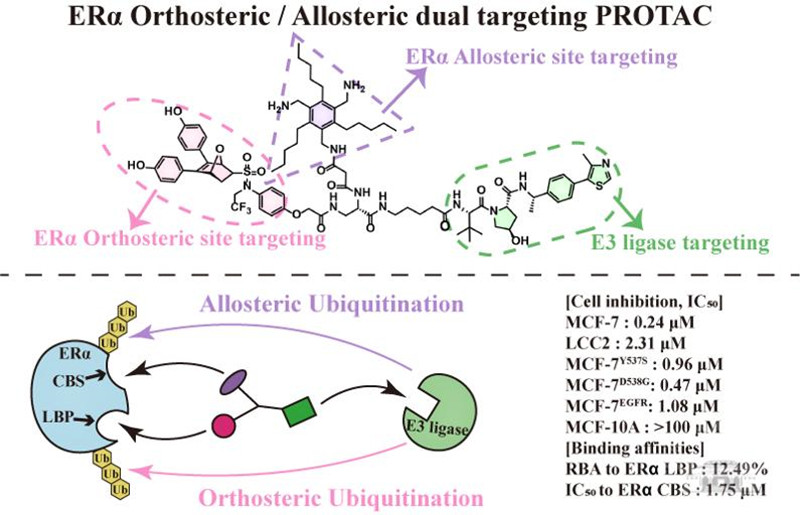
The other research, A Novel Dual-Targeting PROTAC Overcomes Endocrine Resistance by Engaging Orthosteric and Allosteric Sites of Estrogen Receptor α, integrated LBP and CBS ligands into a single PROTAC molecule, enhancing affinity and selectivity through the LBP end while conferring mutation resistance via the CBS end, achieving complementary advantages of orthosteric and allosteric site targeting.
These findings present a new paradigm for designing next-generation anti-resistance drugs: targeting key proteins across different signaling axes or intervening in multiple functional domains of the same target protein.
 中文
中文