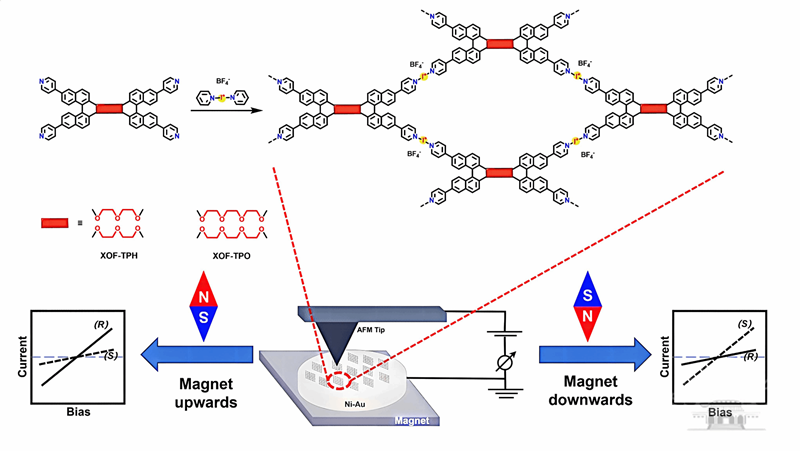
Researchers from Wuhan University's Institute for Advanced Studies, led by Chen Shigui, in collaboration with Guo Cunlan from the College of Chemistry and Molecular Sciences, have achieved a significant breakthrough in spintronics, with their latest research, Supramolecular Chiral Halogen-Bonded Organic Frameworks Enhance Efficient Chirality-Induced Spin Selectivity, published in the journal Angewandte Chemie International Edition.
The team introduced a novel class of two-dimensional donor-acceptor type XOFs, constructed using chiral crown ether units and three-center four-electron [N···I+···N] halogen bonds.
These frameworks, designated as (R/S)-XOF-TPH and (R/S)-XOF-TPO, allow fine-tuning of molecular flexibility by adjusting the length of ethoxy groups, thereby influencing the materials' crystallinity. Both the monomers and XOFs exhibit distinct Cotton effects, indicating stable chiral structures.
The XOFs show enhanced conductivity and spin polarization compared to their monomer counterparts, attributed to their orderly structural arrangement and the heavy-atom effect of iodine. The superior crystallinity of XOF-TPH further amplifies the CISS effect compared to XOF-TPO. Remarkably, when the ferromagnetic substrate is magnetized, (R)-XOF-TPH achieves a spin polarization rate of up to 94 percent.
 中文
中文