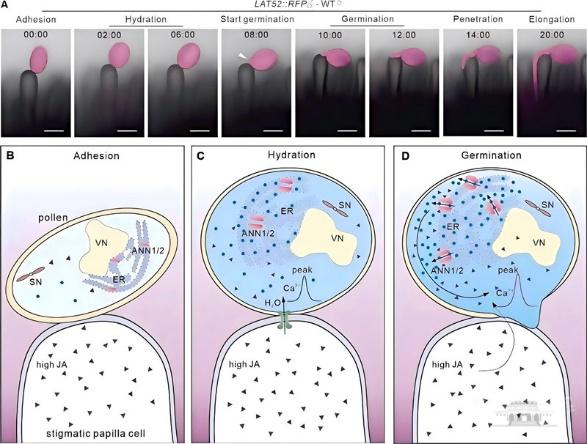
Professor Peng Xiongbo and his team from Wuhan University's College of Life Sciences have revealed a novel regulatory mechanism by which the plant hormone jasmonic acid, secreted by the stigma, promotes pollen germination.
The study, Stigmatic papilla cell secretes jasmonic acid to promote pollen germination through calcium signaling, published in Molecular Plant, demonstrates that maternal factors provided by the stigma, jasmonic acid, play a crucial role in ensuring rapid pollen germination on the stigma by regulating calcium ion channel proteins Annexin 1 (ANN1) and ANN2 in pollen.
The team discovered that a co-culture system of pollen and stigma accelerates and enhances pollen germination rates in vitro, indicating that stigmatic papilla cells secrete a maternal factor that promotes pollen germination.
Through transcriptomic analysis of pollen and stigma, in vitro feeding experiments, and genetic studies, the researchers identified jasmonic acid as a key plant hormone present at high levels in the stigma, essential for rapid pollen germination on the stigma.
Further mechanistic analysis revealed that jasmonic acid promotes pollen germination by elevating calcium levels in pollen through the regulation of calcium ion channel proteins ANN1 and ANN2.
Cross-species pollination experiments among different Brassicaceae species showed that stigma jasmonic acid levels facilitate interspecies pollen germination, suggesting a conserved mechanism.
 中文
中文