Professor Lu Qingquan and his team at Wuhan University’s Institute for Advanced Studies have published their latest findings Electrochemical Cobalt/Vanadium Relay Catalysis: Enantioselective Markovnikov Hydrooxygenation of Alkenes in Angewandte Chemie International Edition, presenting a novel approach to synthesizing pure chiral alcohols from available alkenes.
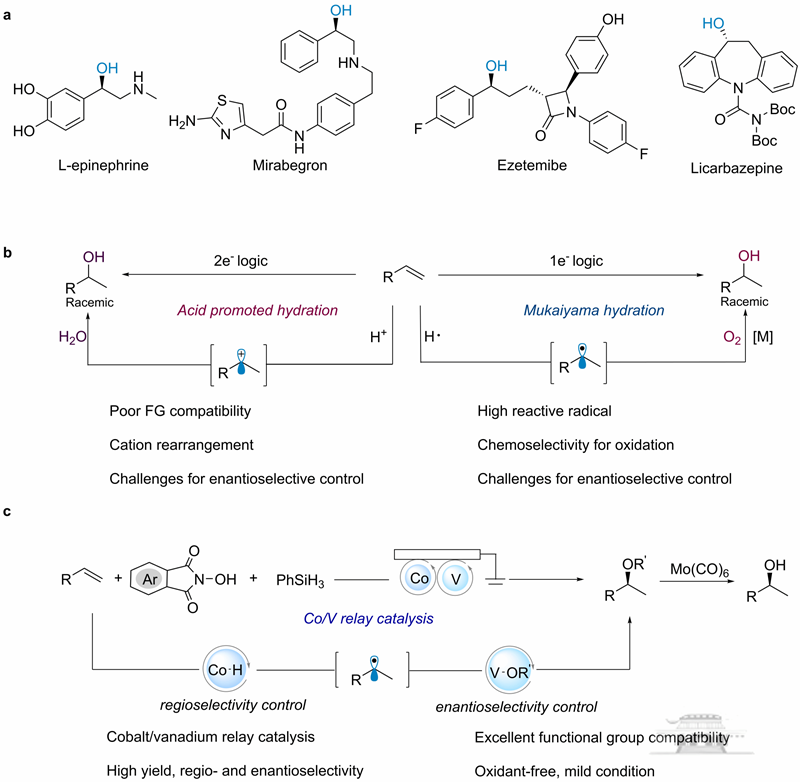
Traditional acid-catalyzed pathways often rely on strong or super acids, which have limitations such as poor functional group compatibility, competitive rearrangement side reactions, and limited chiral control.
Addressing these challenges, Lu's team has introduced an innovative approach using electrochemical cobalt/vanadium relay catalysis, where a cobalt-hydride catalyst selectively activates alkenes through a metal-hydrogen atom transfer process, generating regioselective alkyl radicals.
A chiral vanadium catalyst then mediates the subsequent stereoselective construction, achieving high enantioselectivity in carbon-oxygen bond formation via an outer-sphere bimolecular homolytic substitution mechanism.
Electrochemical anodic oxidation facilitates the valence state regulation and recycling of both cobalt and vanadium catalysts, with hydrogen evolution at the cathode serving as the paired reaction.
This approach eliminates the need for stoichiometric oxidants and operates under mild conditions, suppressing over-oxidation side reactions. The reaction employs N-hydroxyphthalimide as the oxygen nucleophile, and the resulting product can be converted into the corresponding chiral alcohol through simple N-O bond reduction.
The catalytic system demonstrates excellent applicability to both 1,3-enynes and styrenes, accommodating a wide range of functional groups including alkyl, aryl, halogen, ester, aldehyde, and heterocycles.
The team validated the formation of cobalt-hydride intermediates, vanadium-PINO active species, and the radical reaction pathway through cyclic voltammetry, UV-visible absorption spectroscopy, NMR spectroscopy, high-resolution mass spectrometry, and radical clock experiments, clarifying the dual-metal relay catalysis mechanism.
 中文
中文