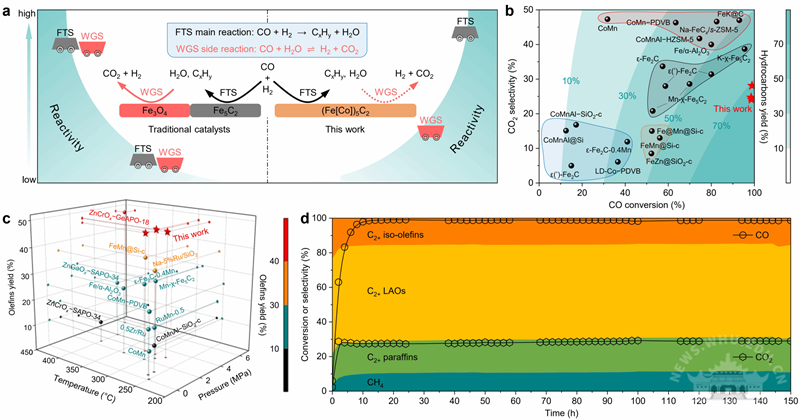
A team led by Professor Ding Mingyue from Wuhan University’s School of Power and Mechanical Engineering has made progress in syngas-to-olefins conversion, with their latest paper, Constructing water-resistant phase-pure alloy carbide for boosting syngas to olefins, published in Nature Communications.
The Fischer–Tropsch synthesis is one of the classic routes for syngas conversion, with iron-based catalysts being used due to their low cost, wide reaction conditions, and tunable hydrocarbon distribution. However, water produced during syngas conversion can oxidize the active iron carbide phase to Fe3O4, reducing catalytic efficiency.
To address these challenges, the team developed a novel approach by constructing phase-pure alloy carbides to modulate water adsorption and reaction behavior, introducing cobalt into the Fe5C2 lattice, constructing a new (Fe[Co])5C2 phase-pure alloy carbide.
Through comprehensive experimental characterization and theoretical calculations, they discovered that cobalt alters the adsorption configuration of water molecules on the metal carbide surface, shifting their behavior from dissociative reactions to direct desorption.
Experimental results show the Fe[Co]Na catalyst achieves a 99 percent CO conversion rate at a reaction temperature of 280 C, while suppressing CO2 selectivity to 28 percent and achieving a hydrocarbon product yield of over 70 percent.
The proportion of high-value olefins in the hydrocarbon products is significant, with a single-pass olefin yield reaching 47 percent, opening a new pathway for efficient syngas-to-olefins conversion under mild conditions and providing new insights for controlling other water-involved reactions.
 中文
中文