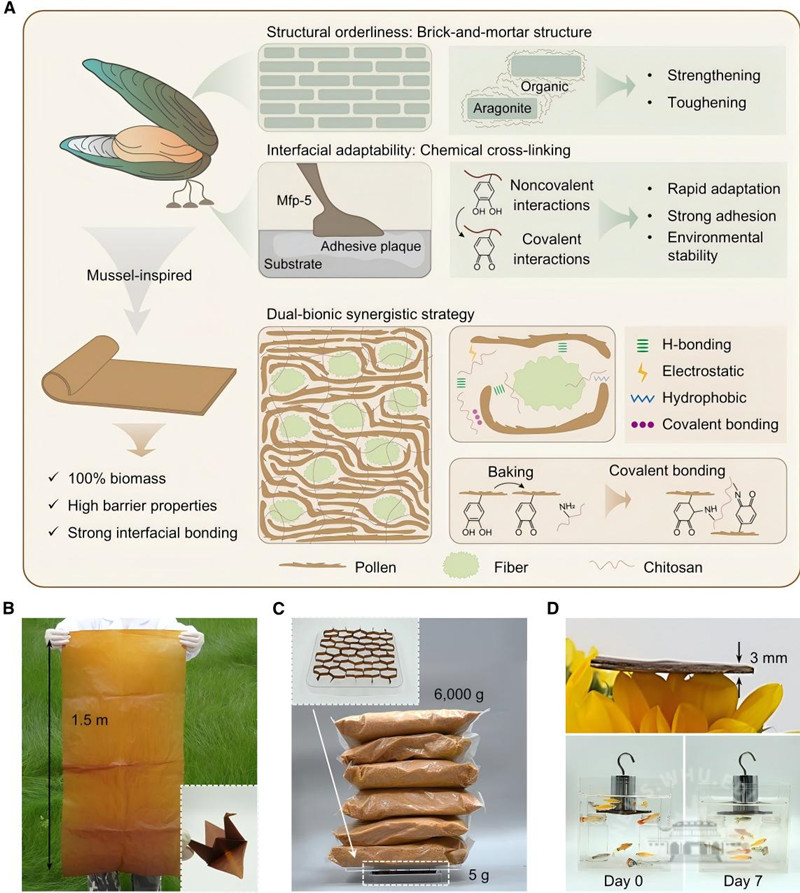
A team led by Professor Deng Hongbing and Associate Professor Zhao Ze from the School of Resource and Environmental Sciences at Wuhan University has published their latest high-performance bio-based barrier materials findings in the journal Matter.
The paper, titled Dual bioinspired structural-interfacial engineering of brick-and-mortar biocomposites for a superior integrated water/gas/UV barrier, has pioneered a multi-scale structural and interfacial synergy approach. This was inspired by the natural "brick-and-mortar" structure of mussel shells and the adhesive mechanism of mussel foot proteins.
This approach promises to achieve high strength, toughness, and barrier properties in bio-based materials, while maintaining environmental friendliness, offering a new bioinspired design pathway for creating high-performance, multifunctional, fully bio-based next-generation barrier materials.
Using pollen microgels, cellulose fibers, and chitosan as primary building blocks, they employed green drying and thermal activation processes to achieve multi-scale ordered assembly and stable covalent cross-linking.
The resulting fully bio-based composite material boasts high strength, flexibility, water resistance, and scalability, with tensile strength approaching 100 megapascals.
The dense multilayer structure and highly tortuous molecular diffusion paths within the material effectively block the transmission of water, gases, and ultraviolet light, achieving multidimensional collaborative barriers.
The ultraviolet protection index exceeds 1,000, and the material retains stable performance even after prolonged water immersion.
 中文
中文