A team led by Jiang Congqing from Zhongnan Hospital of Wuhan University has made significant progress in tumor immune evasion, with their latest findings published in the journal Nature Communications.
The study, In vivo CRISPR screens identify dual functions of DNMT3A in mediating tumor immune evasion, sheds light on the complex mechanisms by which tumors evade immune detection and destruction.
While immune checkpoint inhibitors have revolutionized cancer therapy, their effectiveness in colorectal cancer, particularly in microsatellite-stable patients, remains limited. Tumor cells often employ coupled mechanisms involving epigenetic remodeling, metabolic adaptation, and changes to the immune microenvironment to escape immune surveillance.
To address these challenges, the team developed an in vivo CRISPR screening system targeting epigenetic regulators by conducting comparative screenings in immunocompetent and immunodeficient mouse models.
They identified DNMT3A as a key regulatory molecule. Through integrative multi-omics analyses, clinical cohort validation, and functional experiments both in vivo and in vitro, the team elucidated the molecular networks through which DNMT3A modulates tumor-immune cell interactions.
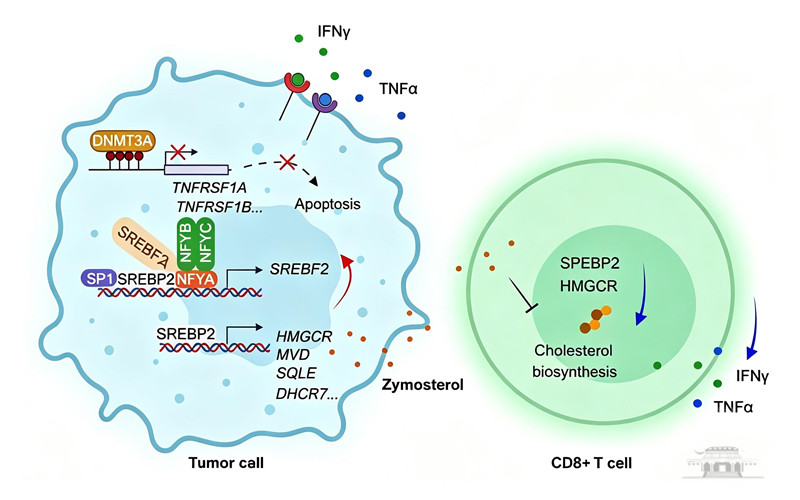
The study reveals that DNMT3A drives tumor immune evasion via two complementary pathways. The first is a methyltransferase-dependent pathway, where DNA methylation suppresses the expression of tumor necrosis factor receptor genes such as TNFRSF1A and TNFRSF1B, reducing tumor cell sensitivity to TNF-α-induced apoptosis and evading immune cell-mediated killing.
The second is an enzyme-independent pathway, where DNMT3A directly binds to the transcription factor NFYA, activating the cholesterol synthesis pathway and promoting the production and release of ergosterol by tumor cells.
Tumor-derived ergosterol inhibits SREBP2 cleavage in CD8⁺ T cells and promotes HMGCR degradation, weakening cholesterol synthesis and antitumor effector functions. Knocking out DNMT3A enhances CD8⁺ T cell infiltration and cytotoxicity within the tumor microenvironment, with metabolic changes also affecting CAR-T cell antitumor activity, thereby establishing DNMT3A as a dual epigenetic-metabolic immune checkpoint.
The team also developed a targeted DNMT3A antisense oligonucleotide combined with a PD-L1 antibody, which inhibited colorectal cancer growth in mice, extended survival, and enhanced CD8⁺ T cell effector function.
Clinical data further showed that high DNMT3A expression in colorectal cancer tissues correlates with lower cytotoxic T cell infiltration, poorer clinical outcomes, and weaker response to immunotherapy.
This study unveils a dual mechanism by which DNMT3A links DNA methylation, cholesterol metabolism, and T cell suppression, providing a new theoretical framework for understanding immune evasion in colorectal cancer.
It also offers experimental evidence for developing DNMT3A-targeted combination immunotherapy approaches.
 中文
中文