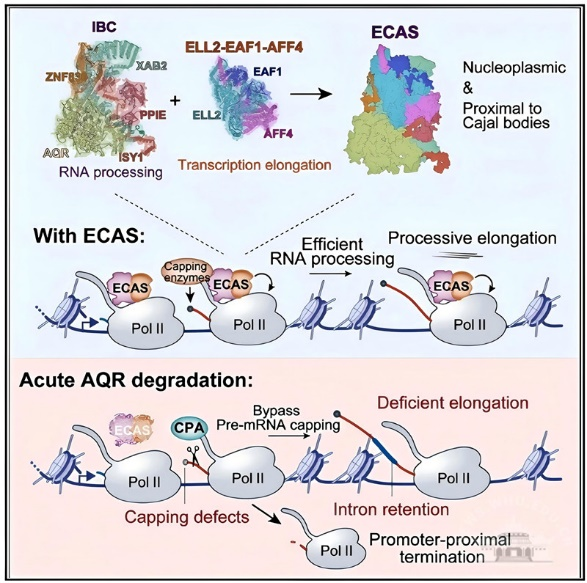
Researchers from Wuhan University’s Taikang Medical School, led by Liang Kaiwei and Fang Pingping, have identified a novel transcription regulatory complex named ECAS (Elongation Complex Associated with Splicing).
Their study, A dual-module ECAS complex couples transcription elongation and RNA processing, was published in Molecular Cell and revealed the complex's critical role in the development of MLL-rearranged leukemia.
The team has long been focusing on the regulatory mechanisms of RNA polymerase II transcription elongation. Previous work identified the Super Elongation Complex (SEC) as a key driver of efficient RNA polymerase II elongation, and linked its abnormal recruitment to MLL-rearranged leukemia.
However, whether a complex could couple transcription elongation with RNA splicing was unclear due to the difficulty of isolating such complexes from chromatin.
By developing a novel proteomics approach for native chromatin, the team identified ECAS, a dual-module complex that links transcription elongation proteins with the intron-binding complex involved in RNA splicing.
AQR, the core component of ECAS, is crucial; its absence impairs RNA polymerase II transcription elongation, reduces RNA capping efficiency, and disrupts splicing.
Focusing on MLL-rearranged leukemia, a cancer driven by fusion proteins from chromosomal rearrangements, the researchers showed that AQR deficiency inhibits leukemia development and maintenance in mouse models and human leukemia cells.
This deficiency also weakens the self-renewal capacity of leukemia stem cells while having a minimal impact on normal hematopoietic cells.
 中文
中文