A study led by Professor Yan Huan of Wuhan University’s College of Life Sciences, in collaboration with international partners, has been published in the journal Nature Microbiology.
The paper, Convergent use of aminopeptidase N receptor by hedgehog merbecoviruses, explores the hedgehog MERS-like coronavirus (EriCoV, also known as HKU31 in the Asian lineage), which is related to the Middle East Respiratory Syndrome Coronavirus (MERS-CoV).
EriCoV belongs to the Merbecovirus subgenus of the Betacoronavirus genus, a major branch recommended for study by the World Health Organization (WHO). These viruses are distributed among hedgehogs across Eurasia and exhibit rich genetic diversity.
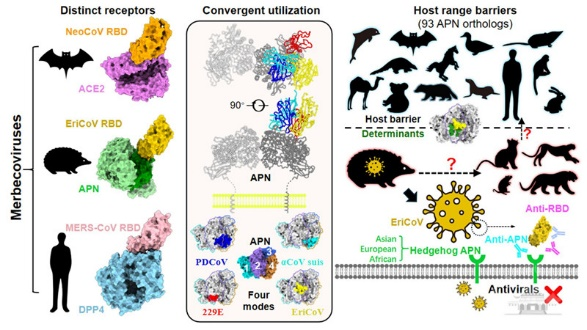
The study reveals that both Asian and European hedgehog MERS-like coronaviruses utilize hedgehog aminopeptidase N (APN) as a functional receptor. Cryo-electron microscopy structural analysis shows that EriCoV primarily recognizes the D2 domain of APN, with a recognition pattern that differs significantly from other known alpha and delta coronaviruses.
This indicates convergent evolution in beta coronaviruses to utilize the APN receptor, paralleling previous reports of convergent evolution in coronaviruses using the ACE2 receptor.
Further analysis explored EriCoV's multispecies APN recognition spectrum, species-specific restrictions, primary hedgehog cell infections, and protease utilization preferences.
By testing APN homologous genes from 93 species, the research found that EriCoV exhibits a narrow APN recognition spectrum. In addition to being highly adapted to certain wild or pet hedgehog APNs, it can also use the APNs of felines such as tigers, leopards, and domestic cats.
However, due to a restrictive glycosylation modification at position N319 of human APN, EriCoV cannot use the human APN receptor. Despite having highly similar RBD structures, EriCoV, NeoCoV, and MERS-CoV utilize three different receptors, highlighting the diversity and complexity of receptor recognition mechanisms in MERS-like coronaviruses.
 中文
中文