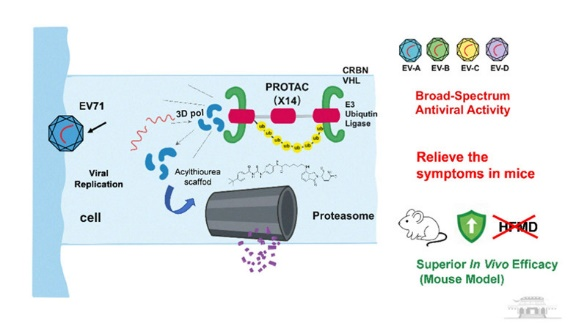
A collaborative team from Wuhan University, including Associate Professor Wu Shuwen from the College of Life Sciences, Professor Zhou Haibing from the School of Pharmaceutical Sciences, and Professor Lan Ke from the State Key Laboratory of Virology and Biosafety, has developed innovative acylthiourea-based PROTACs with broad-spectrum antiviral activity against enteroviruses.
Their findings, Identification of Novel Acylthiourea-Based PROTACs Exhibiting Broad-Spectrum Antiviral Activity against Enteroviruses, have been published in the Journal of Medicinal Chemistry.
Enteroviruses are significant pathogens responsible for infectious diseases such as hand, foot, and mouth disease. Their diversity and genetic variability pose ongoing challenges to public health.
Although vaccines against Enterovirus 71 (EV-A71) are available, they offer limited cross-protection against different enterovirus types, leaving a gap in comprehensive prevention.
There is a lack of effective broad-spectrum antiviral drugs for enteroviruses, highlighting the need for new therapeutic candidates with novel mechanisms of action.
The research focused on the enterovirus 3D polymerase (3Dpol), a critical protein in viral RNA replication and a promising target for antiviral drug development. By inducing the degradation of key viral proteins, the team aims to disrupt the virus replication process, offering a new direction for broad-spectrum antiviral drug development.
The study utilized acylthiourea compounds with known antiviral activity, incorporating a ligand to recruit the CRBN E3 ubiquitin ligase. Through molecular design and structural optimization, the team constructed a series of novel PROTAC molecules, identifying X14 as a promising candidate due to its significant in vitro antiviral activity, effectively inhibiting EV-A71 replication.
Mechanistic studies revealed that X14 targets the viral 3D polymerase, recruiting CRBN E3 ubiquitin ligase to promote degradation of the target protein via the ubiquitin-proteasome pathway, thereby interfering with viral RNA replication.
Compared to the traditional antiviral drug ribavirin, X14 exhibited stronger binding affinity to the target protein. In broad-spectrum antiviral activity evaluations, X14 showed substantial inhibitory effects against various representative viruses from enterovirus types A, B, C, and D, indicating its potential as a broad-spectrum antiviral agent.
Animal experiments further showed that X14 has superior antiviral effects in mice compared to the parent compound, providing a basis for future research on this class of compounds.
This collaborative effort marks the first development of CRBN-recruiting acylthiourea-based PROTAC molecules with broad-spectrum anti-enterovirus activity, validating the feasibility of using CRBN-mediated targeted protein degradation to interfere with viral replication, expanding the application of PROTAC technology in antiviral drug development.
The findings also offer new insights into drug design targeting key viral replication proteins and lay the experimental foundation for the structural optimization and efficacy studies of broad-spectrum anti-enterovirus candidate drugs.
 中文