Professor Zhang Xia from the School of Urban Design and Professor Tang Luliang from the State Key Laboratory of Information Engineering in Surveying, Mapping, and Remote Sensing at Wuhan University have made new advances in revealing the relationship between social media sentiment and depression risk.
Their paper, Depression risk associated with idealized sentiment toward urban places on social media, has been published in the journal Nature Cities and introduces an innovative interpretable deep learning framework, marking the first large-scale quantification of the association between perceptions of urban environments and depression risk using massive social media data across China.
The impact of urban built environments on mental health is profound, yet capturing the subjective emotional experiences of urban residents on a large scale and identifying high-risk groups for depression remains a global challenge in public health and urban studies.
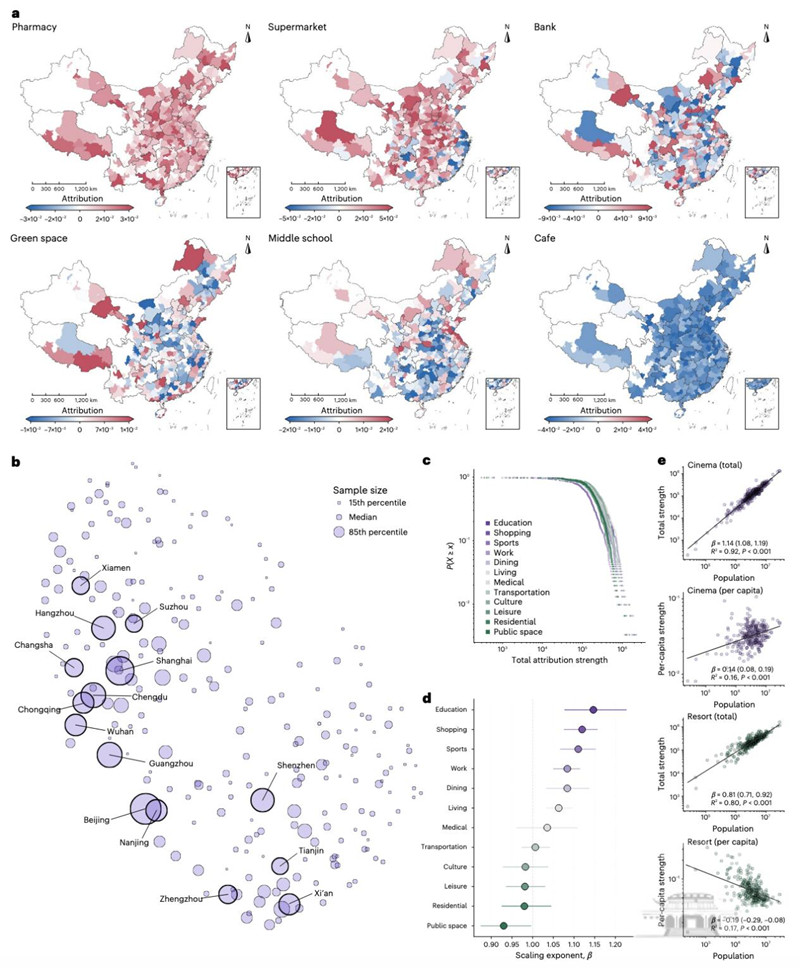
The team introduced the "latent opinion of mood" (LooM) index, integrating it into a novel framework called LooMen (LooM-enabled network). Utilizing millions of social media posts annotated according to the DSM-5 standard from the Sina Weibo Open Dataset (SWDD), the researchers quantified public sentiment toward 88 types of urban points of interest (POI), developing a framework for assessing urban emotional experiences and mental health.
The study uncovered significant emotional differences in how depressed and non-depressed groups express sentiment toward POIs online, providing crucial signals for accurately identifying depression risk.
It also found that positive sentiment does not necessarily equate to good mental health, challenging existing perceptions in urban studies regarding psychological well-being. Moreover, the research identified 34 systematic risk patterns, shifting the focus from single-site attention to a balance of systemic factors in assessing the relationship between urban environments and depression risk.
Through spatial heterogeneity analysis covering 302 cities in China, the study revealed that depression risk signals align with urban population scaling laws. In larger cities, places associated with high-intensity socio-economic interactions, such as shopping and education, show a "super-linear" increase in importance for depression risk identification. In contrast, locations like resorts and scenic spots exhibit a "sub-linear" trend.
This discovery provides new methodologies and insights into the intricate connections between urban environments, social media sentiment, and mental health, paving the way for more targeted public health strategies and urban planning initiatives.
 中文