Professor Zou Xiufen's team from Wuhan University’s School of Mathematics and Statistics has made significant progress in the study of tumor-immune spatial modeling, with their latest research published in the journal Proceedings of the National Academy of Sciences (PNAS).
The paper, Integrating tumor–immune mechanistic modeling with transcriptomics reveals pattern-driven prognostic biomarkers in tumors, is a collaborative effort involving Wuhan University, the Hong Kong Polytechnic University, and the University of California, Irvine.
The tumor immune microenvironment is characterized by significant spatial heterogeneity and dynamic evolution. Mathematical models can dynamically describe tumor-immune cell interactions, while spatial transcriptomics data provide static, high-dimensional information on cell distribution and molecular expression.
Bridging mechanistic modeling and static spatial genomics observations, and linking theoretical mechanisms to real tissue data to understand how tumor immune spatial patterns form and their potential clinical significance, remains a major challenge in this field.
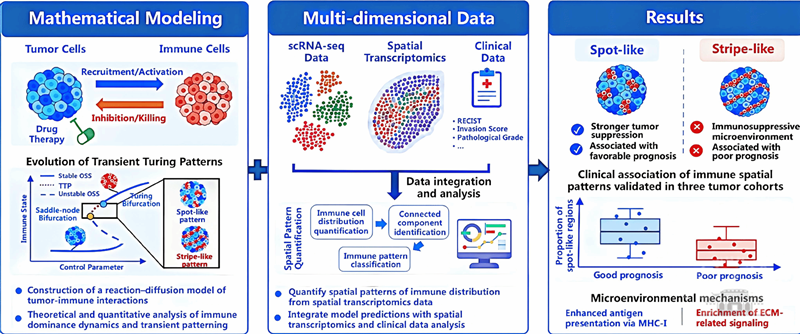
To address this, the research integrates a tumor-immune reaction-diffusion mathematical model with spatial transcriptomics data, building a comprehensive framework that links mechanistic modeling and spatial pattern recognition to clinical correlation analysis.
This framework characterizes the formation and evolution of different immune spatial patterns in the tumor microenvironment and has been validated in multiple independent cohorts, including non-small cell lung cancer, pancreatic ductal adenocarcinoma, and cutaneous squamous cell carcinoma.
The study's results show that different tumor immune spatial patterns exhibit different biological and clinical characteristics. Punctate immune spatial patterns are associated with stronger tumor suppression and better patient prognosis, whereas band-like spatial patterns tend to display immunosuppressive characteristics and are linked to poorer clinical outcomes.
By integrating mechanistic dynamics with spatial genomics data, this research provides a new theoretical and computational framework for understanding the spatiotemporal evolution of tumor-immune interactions.
It also offers a novel research paradigm for identifying spatial prognostic biomarkers and developing personalized treatment approaches.
 中文