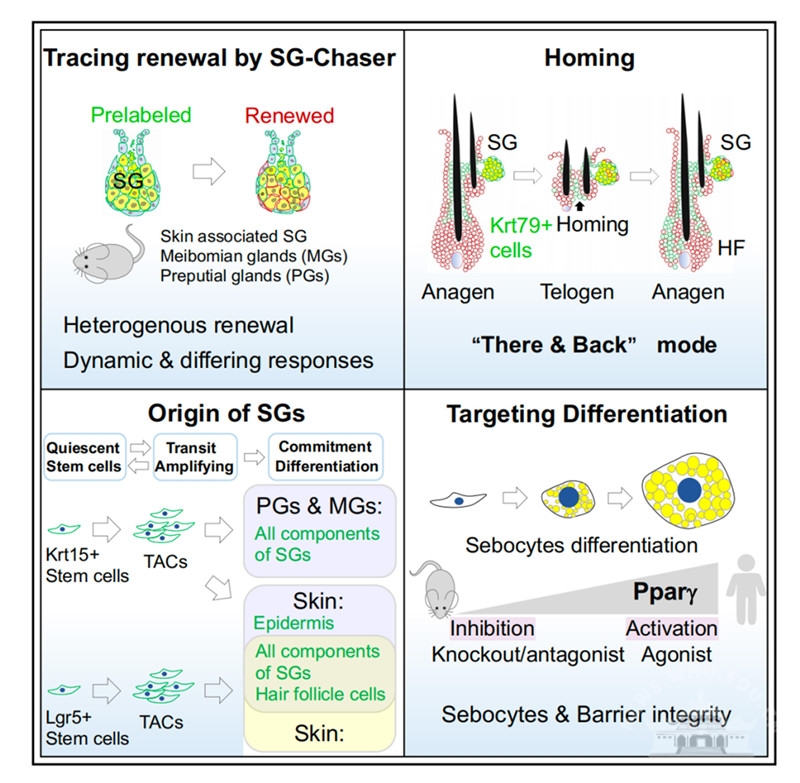
A study led by Professor Zhang Zhuzhen of Wuhan University’s College of Life Sciences, in collaboration with Professor Zhang Lihua from the School of Computer Science, reveals key insights into sebaceous gland renewal and differentiation and their role in maintaining the skin barrier.
The paper, Lineage and renewal dynamics of sebaceous glands govern skin barrier integrity in mice, has been published in the journal Proceedings of the National Academy of Sciences of the United States of America (PNAS).
Using transcriptome sequencing and subsequent screening, the team identified candidate marker genes for sebaceous glands and created a specialized mouse model to target these glands in vivo. Through genetic lineage tracing and single-cell sequencing, the study identified subtypes, differentiation trajectories, and renewal rates of sebaceous gland cells under steady-state conditions, as well as their responses to environmental and dietary factors.
A key finding is the homology between sebaceous gland and hair follicle cells, with KRT15+ cells contributing to various sebaceous gland and hair follicle cell types. During hair growth, proliferating KRT79+ cells act as progenitor-stem cell intermediates.
These intermediate cells can differentiate into mature sebaceous gland cells or dedifferentiate and home back to stem cells. Once returned, these stem cells no longer express KRT79 and can redifferentiate into sebaceous gland and hair follicle stem cells.
Previous research by Elaine Fuchs' group identified homing properties in hair follicle stem cell intermediates, while Mayumi Ito's team discovered similar dedifferentiation traits in melanocyte stem cells in the skin.
The study also highlights similarities between sebaceous and adipocyte differentiation, both lipid-rich and dependent on the transcription factor Pparg. The engineered mouse model for targeting sebaceous glands lays a foundation for future in vivo studies on sebaceous gland characteristics and functions.
The research also explores how sebaceous glands respond to environmental temperature, diet, and topical Pparg agonist application, as well as the dedifferentiation and redifferentiation properties of stem cell intermediates.
 中文