A team led by Professor Wang Shun from Wuhan University has made strides in understanding the mechanical behavior of lunar soil, with its latest study, High-Fidelity Lunar Mare Agglutinates and Their Mechanical Effects on Lunar Regolith Simulants, published in the Journal of Geophysical Research: Planets.
Current lunar soil simulants often overlook agglutinates, and few studies have linked their microstructure and particle failure to macroscopic mechanical responses. Understanding these relationships is crucial for fully comprehending the engineering properties of real lunar soil.
To address the lack of realistic agglutinate features in existing simulants, the team developed a high-temperature vacuum sintering method to create simulated lunar agglutinates (WHU-A) that replicate the porosity, glass-mineral cementation, and irregular morphology of real lunar agglutinates.
They further developed a lunar soil simulant containing these agglutinates (WHU-1A) that accurately mimics the key structural characteristics of agglutinates found in samples from China's Chang'e-5 mission, providing a new experimental material for studying the engineering mechanics of lunar soil.
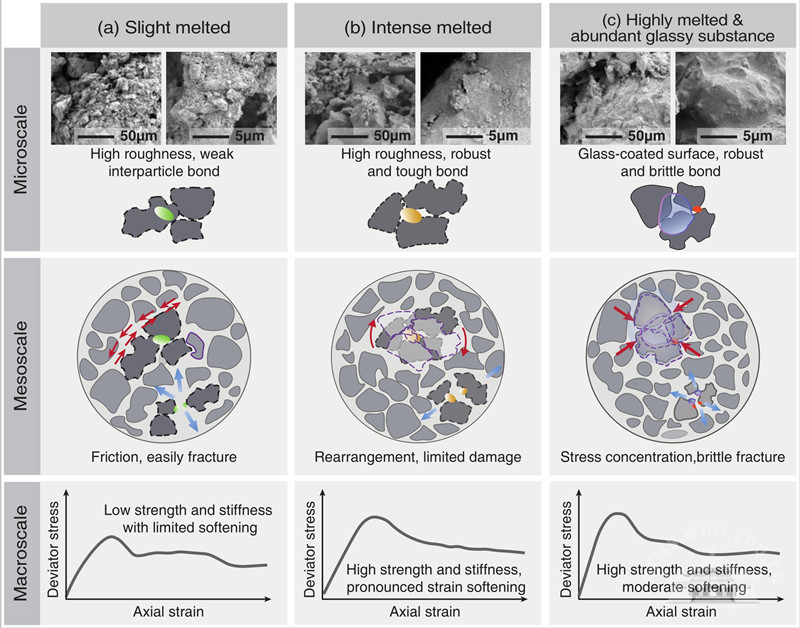
The study's innovation lies in revealing the cross-scale mechanisms by which agglutinates affect the mechanical behavior of lunar soil. Through single-particle compression, repose angle, and small-scale triaxial tests, the researchers analyzed the relationship between agglutinate particle failure and the mechanical response of the particle system.
They established a cross-scale link between the agglutinate microstructure, particle fracture behavior, and the macroscopic mechanical properties of lunar soil.
The findings indicate that agglutinates can enhance the load-bearing capacity of lunar soil through particle interlocking and glass-mineral cementation, while their brittle failure causes the soil to soften after reaching peak strength.
The study also sheds light on how agglutinates formed through space weathering affect the load-bearing capacity, deformation, and failure behaviors of lunar soil, providing deeper insights into the relationship between its microstructure and macroscopic mechanical response.
 中文