Professors Cai Tao and Li Xue from Wuhan University's College of Chemistry and Molecular Sciences have made important advancements in photocatalytic hydrogen peroxide (H₂O₂) production.
Their research, Hollow Conjugated Microporous Polymers Anchored with ZnxCd1-xS Quantum Dots: An Additive-Free Photocatalyst for H₂O₂ Synthesis via S-Scheme Charge Transfer, has been published online in Advanced Materials, addressing the challenges of rapid charge carrier recombination in single-component photocatalysts and the low efficiency of H₂O₂ production via 2e⁻ oxygen reduction reaction (ORR) in pure water without sacrificial agents.
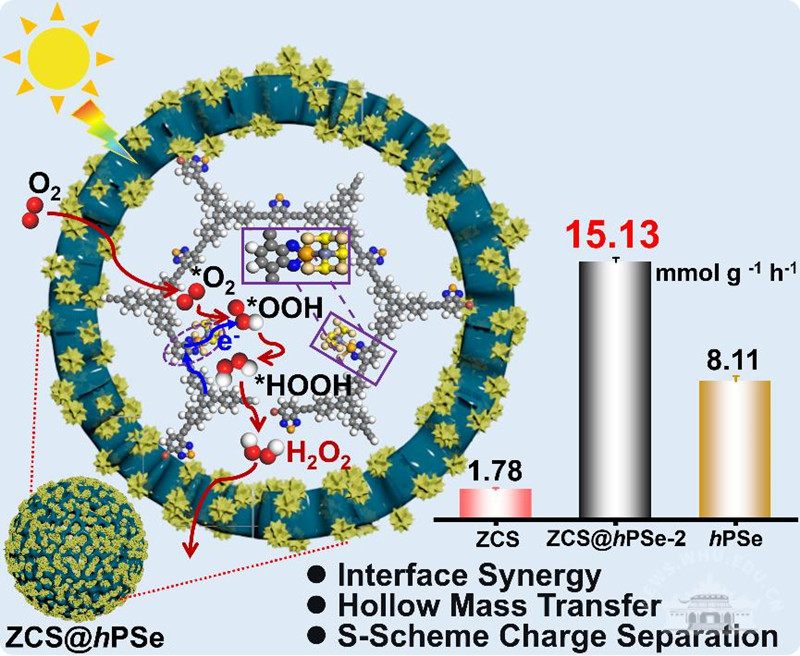
The team developed an in situ growth method for ZCS quantum dots within hPSe, forming an S-scheme heterojunction that provides high surface area and abundant channels for quantum dot anchoring, mass transfer, and light capture.
Under pure water and sacrificial agent-free conditions, the optimal sample, ZCS@hPSe-2, achieves an H₂O₂ production rate of 15.13 ± 0.25 mmol g⁻¹h⁻¹, with an apparent quantum efficiency of 8.82 percent under 400 nm light irradiation and a synergy factor of 1.53.
This performance surpasses that of unmodified hPSe (8.11) and pure ZCS (1.78). Compared with a thiazole-containing control system, ZCS@hPTh-2, the selenadiazole system, has a lower synergy factor but shows superior absolute activity, reproducibility, and long-term stability.
The composite material remains stable after eight cycles, with metal leaching levels lower than those of unmodified ZCS.
 中文