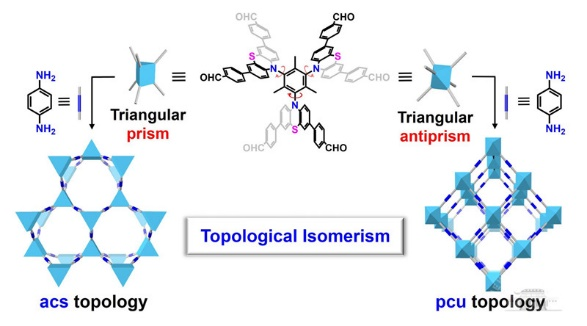
A team led by professors Wang Cheng and Gui Bo from Wuhan University’s College of Chemistry and Molecular Sciences has published its latest research, Prismatic and Antiprismatic Conformations of a Six-Connected Node Direct Topological Isomerism in Three-Dimensional Covalent Organic Frameworks, in the Journal of the American Chemical Society.
The research marks the first successful demonstration of topological isomerism in high-connectivity three-dimensional covalent organic frameworks (3D COFs), revealing how conformational changes in high-connectivity nodes affect framework topology.
High-connectivity 3D COFs are renowned for their high surface area, multidirectional interconnected channels, and diverse topological types, making them highly promising for applications in gas adsorption and separation, catalysis, and sensing.
Building on their previous work on conformational control of stereogenic nodes, the team designed and synthesized a novel, conformationally versatile six-connected fluorescent stereogenic node (TMTPHB).
By adjusting reaction conditions, this molecular precursor can form two distinct 3D COFs with p-phenylenediamine: 3D-TMTPHB-COF-acs and 3D-TMTPHB-COF-pcu. Electron diffraction revealed that the two 3D COFs exhibit sixfold IIIa-class interpenetrated acs topology and sixfold IIa-class interpenetrated pcu topology, respectively.
The two topological isomers show significant differences in fluorescence properties and sensitivity to TNP detection, highlighting that conformational control of high-connectivity nodes is an effective approach for constructing topological isomers and expanding the structure and functionality of 3D COFs.
 中文