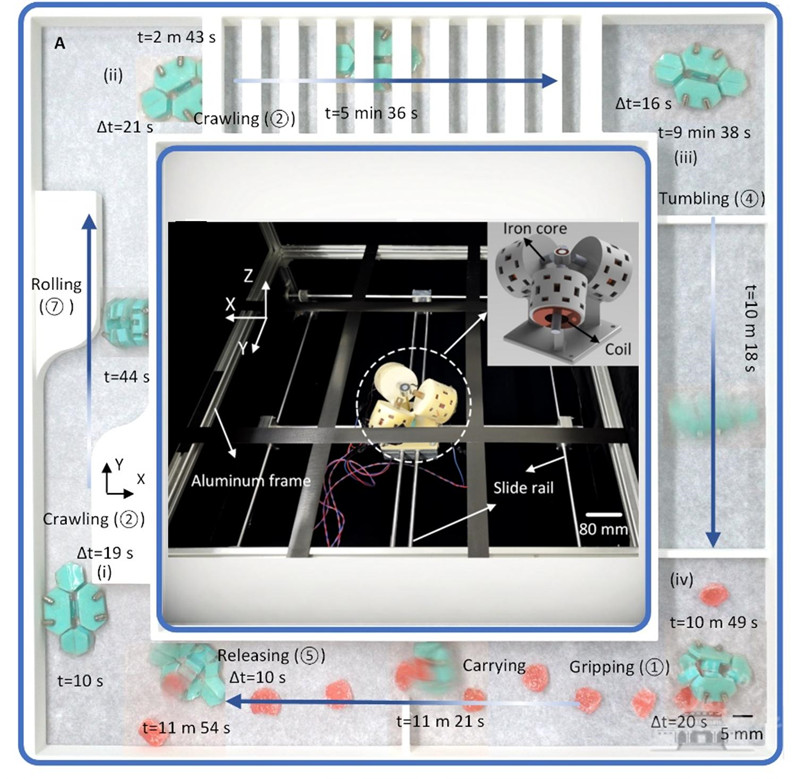
A team led by Professor Li Yang from Wuhan University’s School of Integrated Circuits has made advancements in bistable origami structures and magnetically controlled robots.
The paper, Bistable origami robot for adaptive multimodal motion actuated by nonuniform magnetic fields, describes a novel robot that utilizes its structural deformability and is driven by large-scale, non-uniform magnetic fields.
This innovation enables it to perform a variety of functions, including crawling, turning, rolling, jumping, and grasping, offering new possibilities for flexible micro-robot movement in larger spaces.
The research, published in Nature Communications, marks a departure from the traditional approach of relying on external magnetic fields to control every movement. Instead, the robot's structure itself plays a crucial role in its operation.
The team endowed the robot with two stable configurations. Under minor magnetic disturbances, it can deform within its current configuration to achieve different movement modes. When a larger pulsed magnetic field is applied, the robot can switch to another stable configuration, completing various motion and operational tasks.
The origami structure also possesses a "self-locking" capability. Once the magnetic field drives the robot to close around an object, it can maintain its grasp even after the external magnetic field is removed, without continuous energy consumption.
The team used the robot to grasp live silkworm pupae samples, as well as spheres, cubes, and tetrahedrons, showing it can hold targets even after falls and resist pulling forces.
The robot is still in the experimental research phase and faces several challenges before it can be applied to real-world medical scenarios.
The team plans to further refine the robot's materials, study its performance in complex fluid environments within the human body, and integrate medical imaging and micro-nano fabrication technologies.
 中文